
Netflix has transformed the entertainment industry though it’s use of digital technologies, particularly Artificial Intelligence and Big Data. Rather than functioning as your average streaming platform, Netflix has built its brand around highly personalised experiences for their customers that keeps them engaged. Through recommendation systems, predictive algorithms, and data-driven marketing, Netflix creates an experience that feels tailored to each individual user. This reflects what Davenport et al. (2020) describes in ‘How Artificial Intelligence Will Change the Future of Marketing‘, that AI allows businesses to improve customer engagement through predictive analytics and personalised experiences.
The Role of Big Data in Decision Making
One of Netflix’s strongest uses of digital technology is it’s use of Big Data to improve both their user experience’s and business performance. Gandomi and Haider (2015) explain in the article ‘Beyond the Hype: Big Data Concepts, Methods, and Analytics‘, that Big Data is categorised by volume, variety, velocity, veracity, value, and variability. Netflix demonstrates these by collecting large amounts of data from millions of users worldwide. This is done by Netflix processing structured data, such as viewing history, as well as unstructured data, like search behaviour and user engagement patterns. Nadeem and Nasir (2021) explain in their literature review ‘Impact of Big Data on Innovation, Competitive Advantage, Productivity, and Decision Making’ that businesses use Big Data analytics to create competitive advantage and improve strategic decision making, which is reflected in Netflix’s ability to predict what audiences are likely to watch, which can help guide decisions about what original content (Netflix original series and movies) to produce next.
Analysing Big Data can also help Netflix determine which shows to renew;


and which shows to cancel;


AI Personalisation and Recommendation System
Netflix also heavily relies on it’s recommendation algorithm on the Netflix homepage. And according to Puntoni et al (2021) in the article ‘Consumers and Artificial Intelligence: An Experiential Perspective‘, this reflects a “classification” AI experience, where AI analyses consumer data to identify patterns, preferences, and behaviours.
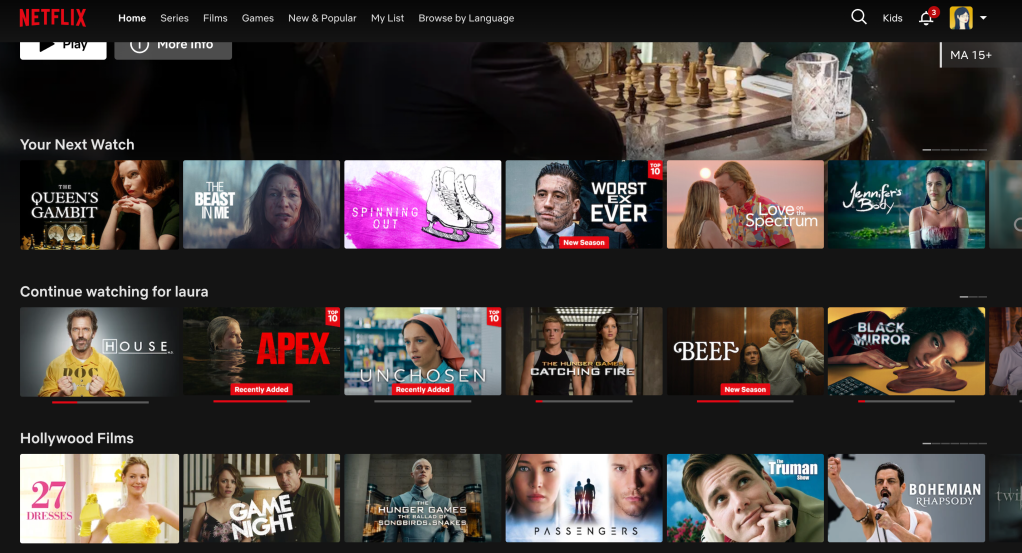
As you can see in this screenshot of my personal Netflix homepage, my recent watches are mainly crime and thriller, and the shows listed in ‘Your Next Watch’ also have a lot of crime and thriller recommendations. This is because Netflix tracks viewing history, watch time, pauses, rewatches, likes, searches, and even the thumbnails that are being clicked the most, in order to recommend personalised content. So, rather than showing the same homepages to every user, Netflix creates unique recommendations for each individual, which makes them feel “understood”, which Puntoni et al (2021) identifies as one of the positive psychological outcomes of AI personalisation.
Conclusion
Overall, Netflix demonstrates how digital technologies can strengthen customer engagement and competitive advantage against other streaming platforms. Through AI personalisation, Big Data analytics, and predictive algorithms, Netflix creates an experience that feels special and convenient. As digital technologies continue to evolve, Netflix’s success highlights how companies can use data to understand consumers and shape future consumer behaviour.
AI declaration: I used ChatGPT for ideas and organising my paragraphs.
Date Published: 15th of May
Author: Laura Martin
Category: Digital Technologies


Leave a comment